Show up on three separate days in week one and your team has a 55% chance of still using its AI teammate a month later. Show up once, and the odds fall under 1%.
That is roughly a 69x gap, and it comes from our own usage data at Appy, across roughly 1,000 organizations. When I first saw it, I assumed a bookkeeping error. We checked. It held. Three days in week one is the strongest predictor we have of whether a team keeps its AI teammate or quietly abandons it.
The obvious suspect is volume, the eager team cramming thirty tasks into day one. Volume is a weak signal. The best cut we could build by sheer task count topped out around 26% still active at 30 days. Three separate days more than doubles that. Three small asks across a week. That is the behavior the 55% have in common.
Why does a week-one habit matter this much? Because the stakes keep widening.
Companies in the top quarter of AI spending have seen median revenue growth of roughly 105 to 110% since late 2022. Companies spending nothing on AI have grown about 18 to 20%, roughly the pace of the broader economy. That second number is what makes the first one sting.
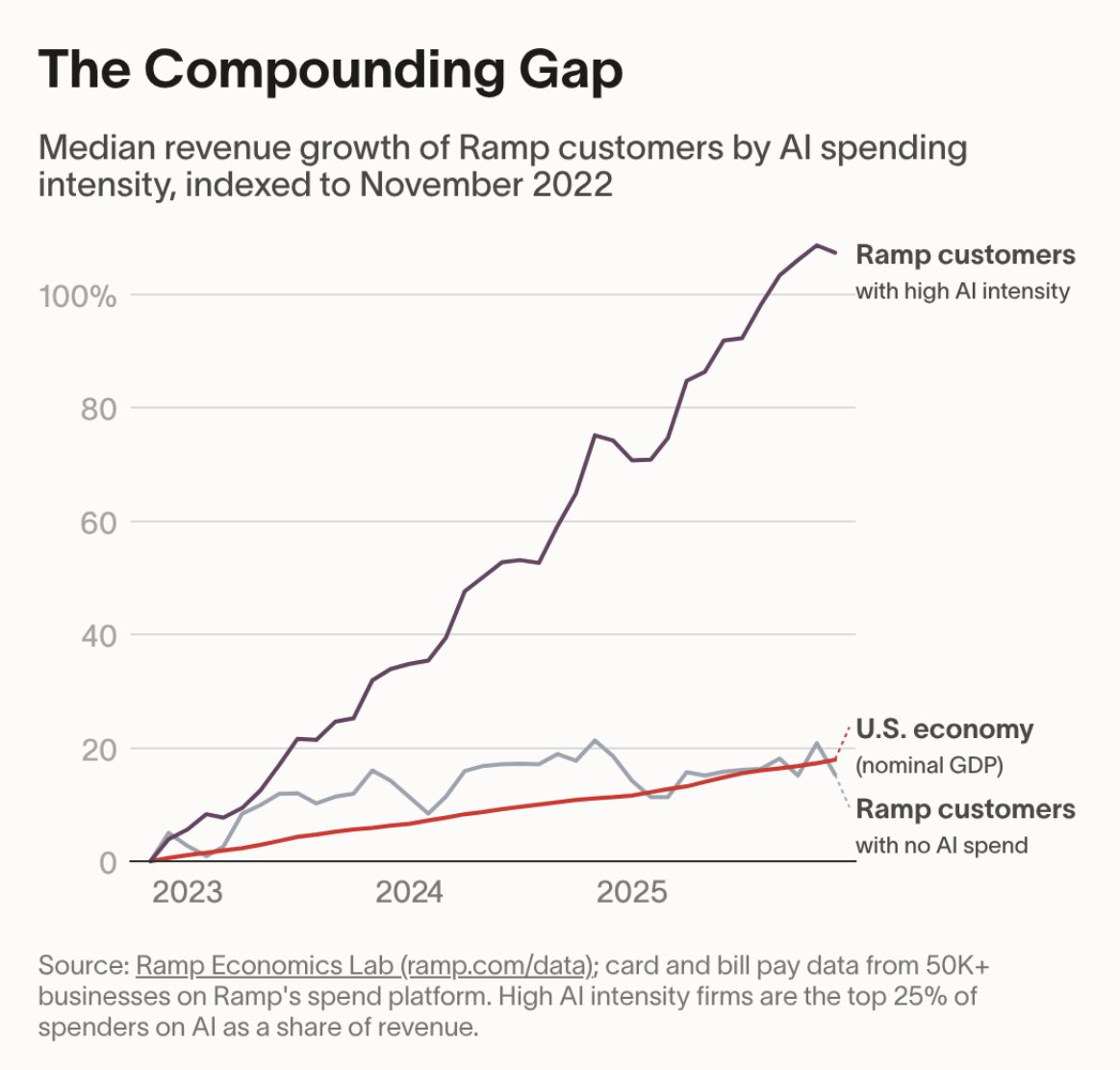
The figures come from Ramp Economics Lab, built on card and bill pay data from more than 50,000 businesses. Treat them as correlation, not a controlled experiment: Ramp measures what its own customers spend and how those customers grow. But the shape of the gap is hard to wave away.
Whatever the top spenders are getting from AI, it behaves like a practice. It builds with repetition, and it punishes waiting.
The second study should set your expectations. Ramp Economics Lab, working with Revelio Labs, tracked AI spending against workforce data at more than 21,000 U.S. firms. The finding: hiring gains arrive 6 to 12 months after adoption, and only at firms spending intensively.
That is a long time to wait on faith. And half-hearted adoption showed no measurable effect at all.
Ramp’s own read is that it takes that long for good habits to spread through a team’s real workflows. Which makes the week-one finding feel less like trivia. Showing up on three separate days is what the spread looks like at the beginning, while it’s still cheap to start.
Here is the finding I least wanted to be true, because testing in private is exactly what I would have done.
Organizations working with their AI teammate in shared channels ran about 18 times the tasks, stayed active roughly 4 times longer, and pulled in about twice as many participants as organizations using it only in direct messages.
The DM-only number is worse. Those organizations performed statistically the same as organizations that never installed it at all. That second clause is the one I keep thinking about. Private use, inside the same Slack your team already lives in, behaved like absence.
The channel does the teaching. When AI work happens out loud, everyone sees the prompt, the output, and the correction. Tuesday’s good prompt sits there for anyone to steal on Wednesday. The fix (“pull last quarter too”) reaches the next person before they make the same miss. One person getting quietly good at AI helps one person.
There is a second advantage here, and we have no data on it, so weigh it accordingly: a channel lets more than one person work with the AI teammate at once. Someone adds context the first person lacked. Someone else redirects the ask. Nobody re-explains the background. Teams rarely think of AI as something two people do together, and a private chat tab makes it structurally impossible.
A chat tool works from what you paste into it. A teammate connected to your CRM, inbox, calendar, or books pulls the real numbers itself. Context is the ceiling on usefulness, and each connection raises it.
Our data adds a wrinkle I find genuinely strange. One connection roughly triples a team’s odds of still being active at 30 days. Then the lift evaporates. By 90 days, teams with one connection land level with teams that connected nothing. Durable use arrives with a second system, whenever it arrives. Connecting on day one, the move every onboarding flow pushes, predicted nothing either way.
The last finding is the one that cuts against my own instinct. Teams that split week one across two specialists retained slightly worse at 30 days than teams that went deep on one, and identical by 90 days.
Sampling the roster early doesn’t accelerate anything. Breadth is a symptom of engagement, showing up afterward on its own. Going deep on one job is what gets a team there. Boring is the goal. Boring means it works.
The whole test fits in a normal week.
One thing that shapes how fast week one can start: where the agent lives. If your team uses Slack, setup is usually one click. If you're on Microsoft 365, how a Microsoft Teams AI agent gets approved and installed takes a few more steps — worth knowing before you plan your three-day window.
Pick one channel your team already lives in. Hand the AI teammate one real recurring task: the Monday pipeline summary somebody builds by hand, the weekly content recap, the check on overdue invoices. Touch it on three separate days, out loud, in the channel. Bring one colleague in from the start. Connect one system now, and plan a second within a few weeks. Let the clumsy parts happen in public, because the clumsy parts are where the team learns.
Then treat the task like a process a person owns. Someone tweaks the report format in week two, and that tweak becomes the default in week three. The real health check is simple: people are still reacting to the output.
One disclosure, since you’ve read this far. We build one of these. Appy’s specialists hold standing jobs. Violet routes the work. Sage runs the finance checks. Piper chases outreach follow-ups. Paige builds the weekly content recap. Everything above comes from watching teams use them, and every bit of it applies to whatever AI teammate you’re evaluating.
The teams in the 55% did nothing heroic. They came back on Wednesday.